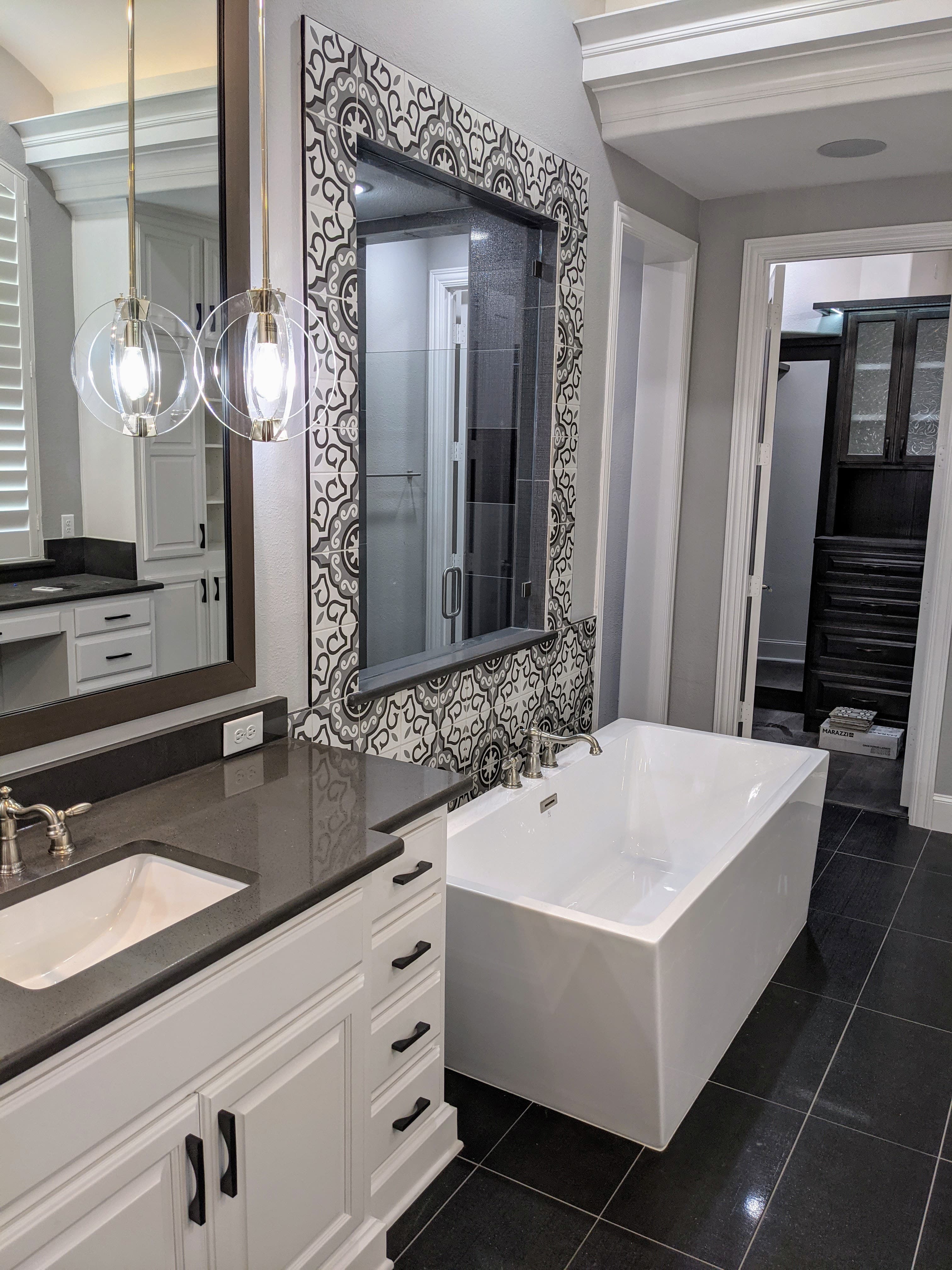
The corner garden tub is the most reliably wasted square footage in a Collin County primary bath. Builders dropped them into thousands of 1990s and 2000s homes across Allen, Plano, Frisco, and McKinney as a selling feature, and a generation of owners has filled them maybe twice — while showering in the cramped stall beside it. Converting that tub to a real walk-in shower is one of the most-requested moves in a bathroom remodel, and like most bathroom work, the honest version is a small plumbing-and-waterproofing build, not a swap you can finish over a weekend.
Moving the drain is the part people underestimate
A tub and a shower drain in different places, and that single fact drives the whole job. A tub drains at one end of its footprint; a shower drains from the center, or along a linear slot against a wall. So a genuine conversion almost always means relocating the drain — and on these slab-on-grade homes the drain lines live inside the concrete, which means cutting the slab, re-routing the pipe, and re-pouring, with a licensed plumber filing a plumbing permit and passing a rough-in inspection before anything closes. That slab work is the difference between a shower that drains correctly and one that pools, and it's precisely the step a tub-shaped drop-in shower kit is designed to avoid — at the cost of a floor that never slopes the way it should.
Valve, supply, and the anti-scald code
A tub filler and a shower valve are not the same fixture at the same height. Converting means opening the wall to rework the supply, set a proper shower valve at a usable height, and run the riser to the head — and code expects that new valve to be a pressure-balancing or thermostatic mixing valve, the anti-scald protection that keeps a flushed toilet elsewhere in the house from sending a spike of hot water at whoever's in the shower. There's no way to do this behind an unopened wall, which is why a real conversion is built from the backer board out, not skinned over the old surround.
The waterproofed wall behind the tile
With the plumbing reworked, the shower becomes the same waterproofing assembly every tile shower is: a sloped pan, a continuous membrane sealing the pan and walls, backer board instead of drywall in the wet zone, every seam sealed and flood-tested before tile. This is the layer that decides whether the conversion lasts, and the one low-bid jobs quietly skip — the tile looks right, the assembly behind it was never built to hold water. A niche, a bench, and frameless or framed glass are the visible payoff riding on top of a box that has to stay watertight for decades. It's the same standard we hold on every job in McKinney or in Frisco, where the housing stock and the Blackland Prairie clay under it are the same story.
Keep a tub somewhere in the house
There's one resale note worth saying plainly: don't take the last tub out of the home. A house with zero bathtubs tends to put off buyers with young children, and appraisers and agents still treat at least one tub as an expectation in a family home. The right move is usually to convert the underused primary garden tub — the one nobody fills — while keeping a tub in a secondary or hall bath, so the household gets the shower it actually uses without narrowing the pool of future buyers. It's general guidance, not a guarantee about any one sale, but it's the pattern that protects the home's value. Our broader bathroom remodeling work and the Collin County permit guide both come back to the same idea: plan the whole house, not just the one room.
Common questions
Do you always have to move the drain to convert a tub to a shower? Almost always, yes. Tub drains sit at one end of the footprint and shower drains run from the center or a linear slot, so the drain location has to change — and on a slab foundation that means cutting concrete, re-routing pipe, and pulling a plumbing permit. A conversion that claims to skip this is usually a liner or drop-in unit sitting over a drain that isn't where a shower needs it.
Can a tub-to-shower conversion be done without opening the wall? Not a real one. Reworking the valve and supply and building a waterproofed tile shower both require the wall open to the studs — the shower is built from backer board and a sealed membrane outward, and the code-required anti-scald valve lives inside that wall. Products that promise an unopened-wall swap are skinning over the old surround, not building a shower to last.
Should I convert my only bathtub to a shower? Generally, no. Keeping at least one tub in the home — usually a secondary or hall bath — protects resale, since buyers with young children and many appraisers still expect one. The common and safer move is to convert the underused primary garden tub while leaving a tub elsewhere in the house.
Does converting the tub add or hurt the home's value? Turning a dated, never-used garden tub into a well-built walk-in shower generally appeals to buyers, provided the home keeps a tub somewhere. It isn't a guaranteed dollar return — that depends on the buyer and the rest of the house — but a code-built, properly waterproofed shower reads as an upgrade, while a leaking or obviously cut-rate conversion reads as a liability.
The Remo Guys runs kitchens and baths as one design-build team — one crew owning the conversion from the relocated drain to the last pane of glass, remodeling homes across Collin County since 2019, insured and bonded, with that single line of accountability as the whole point.
What we handle
- —Tub removal & drain relocation
- —Valve & supply rework
- —Waterproofed shower walls
- —Glass & door options
- —Niche & bench
- —Permits & inspections
Bathroom Remodeling across Collin County
Part of our full bathroom remodeling service — available in every city we cover.
Worth reading first
Tub-to-Shower Conversions — FAQ
- What does tub-to-shower conversions involve?
- A tub-to-shower conversions project with us covers tub removal & drain relocation; valve & supply rework; waterproofed shower walls; glass & door options; niche & bench; permits & inspections. As a design-build team we own design, engineering for North Texas's expansive clay soil, permitting, and construction under one contract — so the plan that's approved is the plan that gets built.
- Do I need a permit for tub-to-shower conversions in the DFW area?
- Yes — tub-to-shower conversions is permitted work across the DFW metroplex. The exact authority, portal, and rules vary by city, so each of our city pages lists the specific permitting details; whichever city you're in, we pull the permit and carry the project through every inspection.
- How much does tub-to-shower conversions cost?
- It depends on the size of the project, the finishes, and any structural or foundation work, so we scope and price each project individually rather than quote a flat rate. To plan around typical DFW ranges, use our cost estimator or the free remodel cost & permit guide.
- Is The Remo Guys licensed and insured?
- Texas doesn't issue a statewide license for residential general contractors, so the real assurance is one accountable team that's insured and bonded — which The Remo Guys has been since 2019. The state-licensed electrical, plumbing, and HVAC trades on your project each pull and inspect their own permits under the build.
Related services
One team for the whole house — here’s what else we build across Collin County.