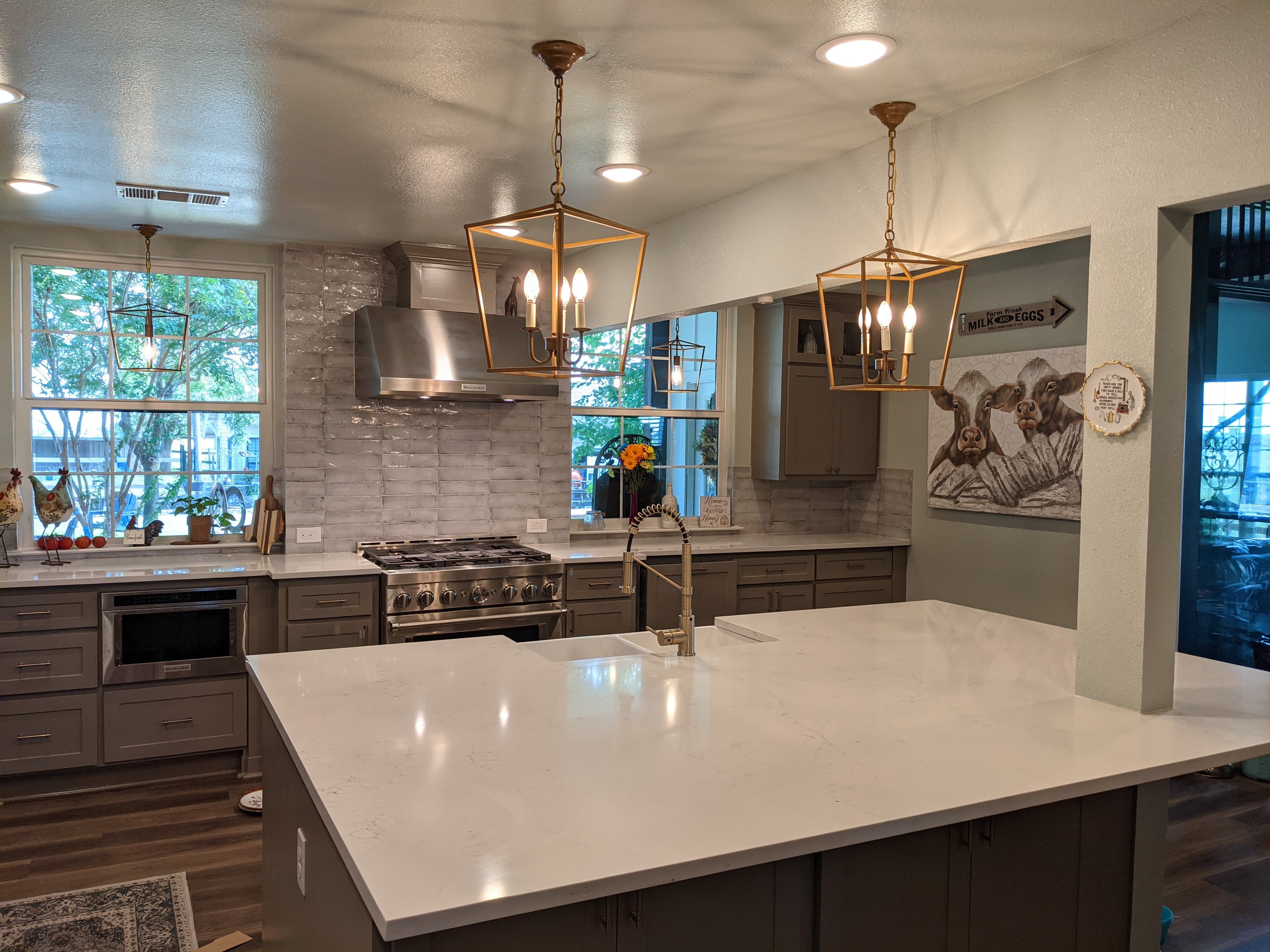
Cabinetry is the part of a kitchen you touch every single day — the doors you open before coffee, the drawers that either glide or fight you, the pantry that's either organized or a landslide waiting to happen. It's also the biggest line item and the one most tied to how the room actually functions, which is why the first real decision isn't a finish color. It's whether to reface the cabinets you have or replace them outright. Get that right and the rest of a kitchen remodeling project falls into place; get it wrong and you either overspend on boxes that were fine, or pour money into refacing a layout that never worked.
Reface or replace — the decision that sets the budget
Refacing keeps your existing cabinet boxes and changes everything you see: new doors and drawer fronts, and a matching wood veneer or laminate skin applied over the face frames and exposed end panels, so a tired kitchen reads as brand-new. It's dramatically less disruptive — the layout stays put, the plumbing and counters can often stay, and the kitchen is usable again in days rather than weeks. It's the right call when the boxes are solid (real plywood or sturdy particleboard that isn't swollen or sagging) and the layout genuinely works for how you cook. What refacing can't do is change the floor plan, add cabinets where there weren't any, or rescue boxes that are water-damaged or falling apart. The moment you want to move a run, take out a soffit, add a pantry tower, or open the wall to the living room, you've outgrown refacing and you're into new cabinetry — because that's the only path that lets the layout change. We'll walk your kitchen and tell you which side of that line you're on before you spend a dollar.
Custom, semi-custom, and a fit to walls that aren't square
New cabinets come in three broad grades, and the difference is fit as much as price. Stock cabinets arrive in fixed sizes and get made to fit with filler strips. Semi-custom offers more sizes and options. Full custom is built to the exact dimensions of your walls — which matters more here than most homeowners expect. Much of Collin County's housing stock — the 1990s and 2000s homes across Allen and Plano — sits on slab-on-grade over expansive Blackland Prairie clay that swells and shrinks with the seasons, and a settled home from that era rarely has walls that are truly plumb or corners that are truly ninety degrees. Cabinets, meanwhile, are built dead square. Closing that gap is craft: scribing the boxes to follow the wall, shimming the bases dead level so the counter above sits flat, and detailing fillers and end panels so the seams read as intentional rather than as a fight with the house. That out-of-square reality — and why it comes from the soil — is worth understanding before you plan a run, and we cover it in our guide to building on Collin County clay soil. It's also why a factory drop-ship without a real field measure so often ends in gaps at the wall.
Soft-close, storage, and a pantry that earns its space
Where cabinets have quietly leapt forward is on the inside. Soft-close hinges and undermount, full-extension drawer glides are close to standard now, and they're the upgrade people notice first — drawers that pull all the way out and close themselves instead of slamming. Beyond that, the storage engineering is what makes a kitchen feel bigger without moving a wall: deep pot drawers instead of a base cabinet you have to crawl into, pull-out shelves and a pantry tower that brings the back of the cabinet to you, dedicated corner solutions so the dead corner stops swallowing your stockpots, vertical dividers for trays and sheet pans, and a pull-out for trash and recycling. Planned together, these turn the same footprint into noticeably more usable space — the real payoff of designing cabinetry around how you work rather than ordering a catalog of matching boxes.
Finishes, hardware, and the trim to the ceiling
The finish is where a kitchen finds its character. Painted cabinetry — typically on MDF or a smooth hardwood, sprayed with a durable catalyzed finish — gives crisp, contemporary color; stained wood shows grain and warmth; and each wants a different door style to look right. Detailing carries the look up the wall: crown molding that runs the uppers to the ceiling (especially worth it on the taller ceilings common in newer Collin County homes, so you're not left with a dust shelf and a gap), light rail to hide under-cabinet lighting, and a toe kick that ties into the flooring. Hardware — the pulls and knobs — is the jewelry that pins the whole style down. Chosen as a set rather than piecemeal, finish, door profile, and hardware read as one deliberate design instead of a mix of decisions made on different days.
Common questions
Is refacing worth it, or should I just replace? Refacing is worth it when your boxes are structurally sound and the layout already works — you get a new-looking kitchen for meaningfully less, faster, and with less demolition. Replace when the boxes are damaged, when you want to change the layout, or when you're adding storage the current run can't hold. The condition of the boxes and whether the floor plan works are the two questions that decide it.
Can you match new cabinets to walls that aren't square? Yes — that's exactly what field-measured, scribed cabinetry is for. On our settled clay-soil homes, walls are often out of plumb, so the cabinets get scribed to the wall and the bases shimmed level. A blind catalog order with no field measure is where you end up with gaps and a crooked counter.
Do new cabinets require a permit? Cabinetry itself is a finish and generally doesn't require a permit. A permit enters the picture only when the surrounding work does — relocating plumbing or gas, adding circuits, or removing a load-bearing wall to change the layout — which is licensed, inspected trade work handled as part of the broader remodel.
Are soft-close and pull-outs available on refacing too? On refacing, new soft-close hinges come with the new doors, and drawer boxes can often be upgraded to soft-close glides. Interior organizers like pull-outs and pantry inserts depend on the size and condition of the existing boxes — we assess that during the walkthrough so nothing's promised that the box can't hold.
Cabinets sit where design, carpentry, and the quirks of an older house all meet, so The Remo Guys plans, fits, and finishes them as one accountable design-build team — scribed to your walls, built for how you actually use the room — remodeling kitchens across Collin County since 2019, insured and bonded.
What we handle
- —Custom & semi-custom cabinetry
- —Cabinet refacing & refinishing
- —Soft-close doors & drawers
- —Pantry & pull-out storage
- —Crown & trim to the ceiling
- —Hardware & finish selection
Kitchen Remodeling across Collin County
Part of our full kitchen remodeling service — available in every city we cover.
Worth reading first
Custom Cabinets & Refacing — FAQ
- What does custom cabinets & refacing involve?
- A custom cabinets & refacing project with us covers custom & semi-custom cabinetry; cabinet refacing & refinishing; soft-close doors & drawers; pantry & pull-out storage; crown & trim to the ceiling; hardware & finish selection. As a design-build team we own design, engineering for North Texas's expansive clay soil, permitting, and construction under one contract — so the plan that's approved is the plan that gets built.
- Do I need a permit for custom cabinets & refacing in the DFW area?
- Yes — custom cabinets & refacing is permitted work across the DFW metroplex. The exact authority, portal, and rules vary by city, so each of our city pages lists the specific permitting details; whichever city you're in, we pull the permit and carry the project through every inspection.
- How much does custom cabinets & refacing cost?
- It depends on the size of the project, the finishes, and any structural or foundation work, so we scope and price each project individually rather than quote a flat rate. To plan around typical DFW ranges, use our cost estimator or the free remodel cost & permit guide.
- Is The Remo Guys licensed and insured?
- Texas doesn't issue a statewide license for residential general contractors, so the real assurance is one accountable team that's insured and bonded — which The Remo Guys has been since 2019. The state-licensed electrical, plumbing, and HVAC trades on your project each pull and inspect their own permits under the build.
Related services
One team for the whole house — here’s what else we build across Collin County.