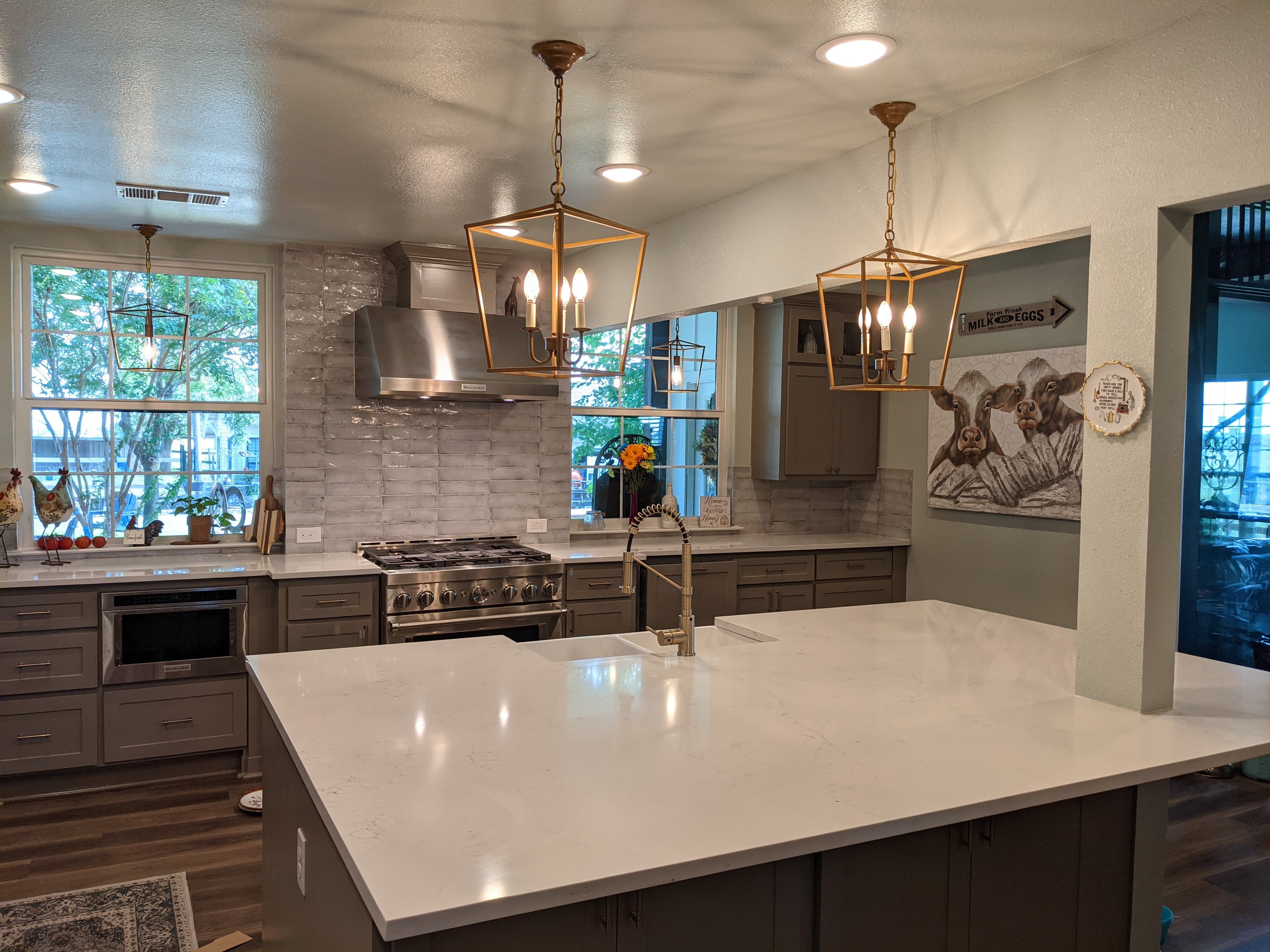
"Just the countertops" is the most under-estimated line item in a kitchen. On paper it reads like swapping a tabletop; in practice, the moment the old top comes off you're touching the sink, the faucet, the disposal, the dishwasher, and sometimes a drop-in cooktop — plumbing and appliances that have to be disconnected to pull the slab and reconnected once the new one is set. That's why we treat a countertop replacement as a small, tightly sequenced project rather than a drop-off, and why it slots neatly under a full kitchen remodeling scope when the layout is changing too.
Why a countertop swap becomes coordinated trade work
To remove an old top, the sink and faucet come out, the disposal and dishwasher drain get disconnected, and any undermount sink gets released from the substrate. The new slab can't be templated until the cabinets underneath are set and level, and it can't be plumbed back in until it's physically installed — so the order is fixed: disconnect, demo the old top, template or install, then reconnect. Skip the coordination and you get the classic stall — a beautiful new counter sitting in the driveway because the plumber and the fabricator were booked on different days and neither owned the handoff. One team scheduling the disconnect, the fabrication, the set, and the reconnect is what keeps a two-day job from becoming a two-week one.
Templating and the slab itself
Modern replacement starts with digital templating — a laser or photo template that captures the exact footprint of your cabinet runs, the sink and cooktop cutouts, the overhangs, and the walls behind. That pattern drives fabrication off-site, so the slab arrives cut to your kitchen rather than trimmed on the spot. The material decides how it behaves for the next twenty years. Quartz is engineered stone — nonporous and consistent in pattern, so it never needs sealing and shrugs off stains. Granite is natural stone, each slab unique, and because it's porous it wants periodic sealing. Porcelain is a sintered slab that's thin, hard, and heat- and UV-stable, which makes it a favorite for waterfall ends and even outdoor kitchens. None of that changes the templating discipline — but it changes edge detailing, seam strategy, and how the fabricator handles the sink cutout, which is exactly why the material choice and the shop have to be planned together.
The plumbing, the sink, and the cooktop
The reconnection is where a counter job earns or loses its warranty. An undermount or farmhouse sink has to be supported and set to the slab so its full weight isn't hanging on a bead of adhesive. The faucet, supply lines, drain assembly, disposal, and dishwasher tailpiece all get reconnected and leak-tested — and this is the moment to replace tired angle stops and supply lines rather than reuse fittings that were already a decade old. If you're only disconnecting and reconnecting fixtures in their existing locations, this is minor plumbing; if the replacement is the excuse to finally move the sink to a window wall, you've crossed into slab plumbing and permitted trade work, and it belongs in a broader remodel. Moving plumbing on a slab foundation is real work in Collin County — the drains live in the concrete — and it's the kind of decision one design-build team should be making with you, not around you. Weighing where the line falls is a big part of choosing design-build over managing your own trades.
Seams, backsplash, and setting level on Collin County clay
Stone slabs have a maximum size, so any large or L-shaped kitchen will need a seam or two — placed deliberately, at a sink or an inside corner, and color-matched with epoxy so they read as a shadow line rather than a scar. The backsplash is the other coordinated piece: pulling an old counter usually damages or removes the existing backsplash, so a clean job plans the new tile or slab backsplash as part of the same scope instead of leaving a raw gap. And underneath all of it is the plane the stone sits on. Many homes across Allen, Plano, and McKinney sit on slab-on-grade over expansive Blackland Prairie clay that swells and shrinks with the seasons, and a settled 1990s or 2000s house can hand you base cabinets that are subtly out of level. Stone doesn't flex — set it on an untrue plane and you get gaps at the wall, stress at the seams, or a crack over an unsupported span. Shimming and leveling the cabinets first, and bracing any long overhang for seating, is what makes the finished top sit flat and stay flat.
Common questions
Do I need a permit just to replace countertops? Replacing a top and reconnecting the sink and appliances in their existing spots is typically a finish job that doesn't trip a permit on its own. The permit line gets crossed when you relocate plumbing — moving the sink, adding an island prep sink, or rerouting a drain in the slab — because that's licensed plumbing work that's inspected. We'll tell you honestly which side of that line your project is on.
Quartz, granite, or porcelain — which holds up best here? All three are durable; the difference is maintenance and use. Quartz is the low-maintenance default (no sealing, very stain-resistant). Granite rewards you with one-of-a-kind natural stone but wants periodic sealing. Porcelain is the most heat- and UV-stable and the thinnest, which suits waterfall edges and outdoor runs. There's no single "best" — it depends on how you cook and how much upkeep you want.
Will the new counter have visible seams? Only if the kitchen is bigger than a single slab, which most full-size kitchens are. Seams are planned into low-visibility spots and color-matched, so they're felt more than seen. A layout with a large island may need a seam by design.
Why do the cabinets have to be level first? Stone can't bend to follow a settled cabinet run. On our clay soils, older homes often need the bases shimmed and leveled before templating, or the finished top will gap at the wall and stress at the seams. It's the unglamorous step that decides whether the counter looks right.
Countertops sit at the intersection of stone, plumbing, and cabinetry, and the seams between those trades are where jobs go wrong — so The Remo Guys runs the whole thing as one accountable design-build team, from the disconnect to the final leak test, remodeling kitchens across Collin County since 2019, insured and bonded.
What we handle
- —Quartz, granite & porcelain slab
- —Precise digital templating
- —Sink & cooktop cutouts
- —Plumbing disconnect & reconnect
- —Backsplash coordination
- —Old-top demo & haul-off
Kitchen Remodeling across Collin County
Part of our full kitchen remodeling service — available in every city we cover.
Worth reading first
Kitchen Countertop Replacement — FAQ
- What does kitchen countertop replacement involve?
- A kitchen countertop replacement project with us covers quartz, granite & porcelain slab; precise digital templating; sink & cooktop cutouts; plumbing disconnect & reconnect; backsplash coordination; old-top demo & haul-off. As a design-build team we own design, engineering for North Texas's expansive clay soil, permitting, and construction under one contract — so the plan that's approved is the plan that gets built.
- Do I need a permit for kitchen countertop replacement in the DFW area?
- Yes — kitchen countertop replacement is permitted work across the DFW metroplex. The exact authority, portal, and rules vary by city, so each of our city pages lists the specific permitting details; whichever city you're in, we pull the permit and carry the project through every inspection.
- How much does kitchen countertop replacement cost?
- It depends on the size of the project, the finishes, and any structural or foundation work, so we scope and price each project individually rather than quote a flat rate. To plan around typical DFW ranges, use our cost estimator or the free remodel cost & permit guide.
- Is The Remo Guys licensed and insured?
- Texas doesn't issue a statewide license for residential general contractors, so the real assurance is one accountable team that's insured and bonded — which The Remo Guys has been since 2019. The state-licensed electrical, plumbing, and HVAC trades on your project each pull and inspect their own permits under the build.
Related services
One team for the whole house — here’s what else we build across Collin County.